

The First Motor and Control Choices
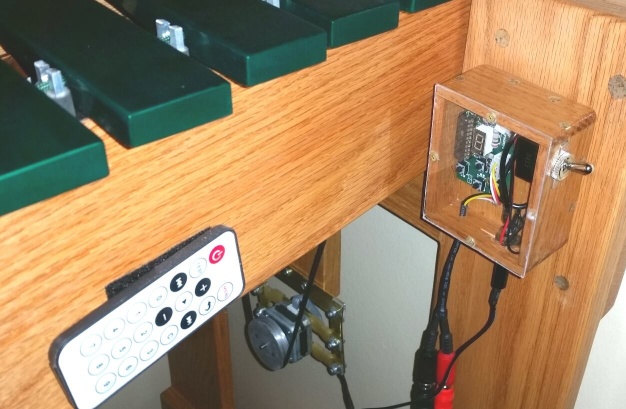
With the Master-Class Vibraphone taking shape, the motor system was next on the list. I'd had a pretty clear picture in my head of what I wanted it to do — but finding the right combination of motor and controller to actually make that happen took some hunting. Eventually I found what I needed on eBay: a digital stepper motor and a matching controller circuit, chosen and paired up specifically because they were designed to run at approximately USB voltage — around 5 to 6 volts. That one decision opened up a world of options.
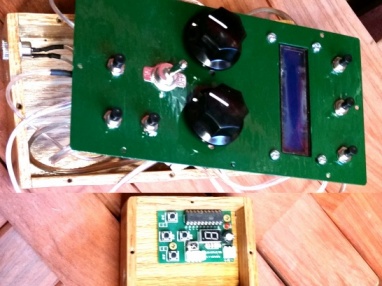
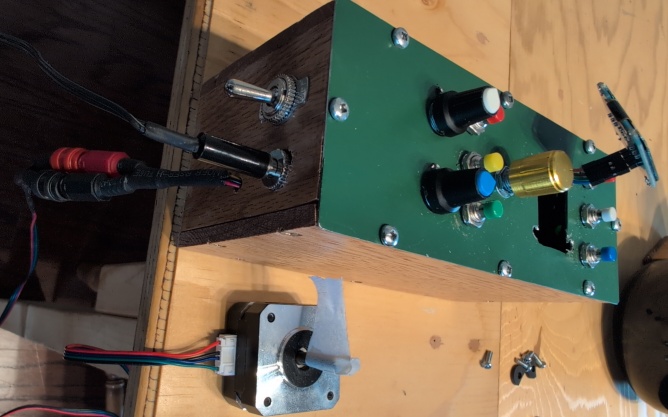
Running at USB power means I can drive the whole system from almost anything — a wall plug pack, a phone charger, a USB battery bank, four standard AA batteries, or even a lantern battery if I want serious portable runtime. I can plug it into a laptop. The flexibility is genuinely remarkable for something so simple, and it was a deliberate choice from the start — I wanted this system to be usable anywhere, not tethered to a power socket. I made a neat little control box from oak to match the instrument frame — the one exception being the faceplate, which had to be clear acrylic so the infrared sensor on the control board could still receive the remote signal.
Stepper motors are fascinating things. Unlike a conventional continuous DC motor that just spins, a stepper moves in precise discrete steps — which means you get exact speed control, both directions, the ability to move to a specific position and hold it, and a range from extremely slow to very fast. The potential for future programmability is real and something I'm already thinking about — with a USB connection there's no reason this couldn't eventually be interfaced with other systems entirely.
The Steps — Getting There

This wasn't actually the first time I'd built a motor system for a vibraphone. The PV Lite Vibes had its own motor setup, built years earlier — and in some ways it established the template for what I was now trying to improve on. That original system was deliberately simple: a small gearhead DC motor with a direct drive connection to a pulley simply sized to get the single speed I desired. Crucially, it ran on battery power — no mains electricity required — which at the time felt like a real advantage and still does. The idea of an instrument that could perform anywhere, untethered from a wall socket, was always part of the thinking.
Two limitations though. The lack of speed control, and noise! — gearhead motors have a gear train, and you can hear it. In the performance settings the PV Lite was designed for it wasn't really a dealbreaker; a live stage has enough going on that a little mechanical hum from the motor gets lost in the mix. In a recording studio it would have been a different story entirely. But the system proved the concept completely — low voltage, battery powered, fits on the instrument, does the job. That foundation was exactly what I was building on now, with a stepper motor that I hoped would finally solve these issues.
The Setup — and the Noise Problem
My first instinct when thinking about motors for the new instrument was actually a historical one. The vibraphone was invented in the 1920s, and those very first instruments used the motors from the record players of the day — turntable motors — to spin the fans. It was an elegant solution for its time, so I went looking for some. I bought a few second-hand record players and pulled the motors out, and some of them were genuinely impressive — remarkably quiet running, and capable of more than one speed. Variable speed control was definitely on my wish list, and these motors had it.
The problem was the how. Turntable motors aren't simple DC motors you can just feed current to and control with a voltage — they have multiple coils, and speed is determined by precisely timed electrical pulses applied to those coils. The control electronics are complex, and in every record player I pulled apart the motor was deeply embedded in the existing circuitry — all of it designed for that specific unit, none of it easy to extract and repurpose. They were also physically quite large. Mounting one cleanly to a vibraphone frame was going to be a serious engineering challenge.
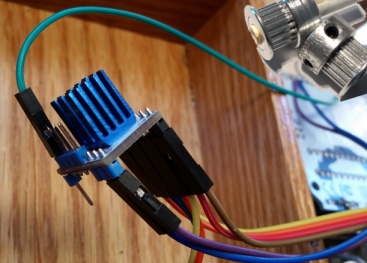
So I started researching the electronics needed to drive and control that type of multi-coil motor independently. That research led me, fairly quickly, to stepper motors — because stepper motors work on exactly the same principle: multiple coils, pulse-controlled, precise speed and position. The difference was that by the time I was looking, stepper motors were already widely available as compact, self-contained units — small enough to mount on an instrument without drama. The control electronics were still complex, but here eBay came to the rescue: a pre-made stepper controller board with a remote control, ready to go, at a price that made experimenting entirely practical. That was the breakthrough that made this whole direction suddenly viable.
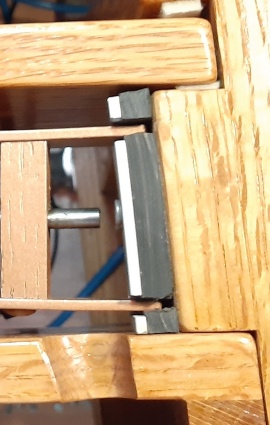
The transmission from motor to fans was done in the traditional way - a rubber O-ring style belt running from the motor all the way around both resonator pulleys in a triangle shape. In the photo the pulleys have been removed, but you can see the groove I cut out of the top of the strut to let the belt run cleanly without contacting the strut. Installation of the motor and control box was kept deliberately simple and flexible. Both the controller box and the remote are mounted on Velcro pads — which means the whole thing can live in a permanent configuration on the instrument, or be peeled off and reconfigured in minutes. The RCA plugs carry power from controller to motor, making removal just as easy. The result is a system that's genuinely plug-and-play: the controller can sit anywhere, go in a pocket, or be handed to someone else entirely.

There was one significant problem though, and I won't pretend otherwise: noise. Like most stepper motors, this one had vibration issues — that characteristic mechanical buzz that conducts straight into the frame if you're not careful. My solution at this stage was to mount the motor via four short lengths of silicone tube, which acts as a vibration isolator between motor and frame. It helped — but it didn't fully solve it.
Another small issue I noticed was slippage of the belt. It wasn't a huge deal... If I made the belt looser it slipped more but if I made it tighter vibration transmitted more through the belt to the resonators. Slippage didn't make its own noise, but it did mean that the two sets of fans would gradually become unsynchronized so that one set of resonators was open while the other was closed instead of them both changing state together. These were problems I noted and parked. Things all worked pretty well for now and refinement would come later.